

Ecologist Ed Turner on the Importance of Sustainable Oil Palm and Collaborating with Farmers
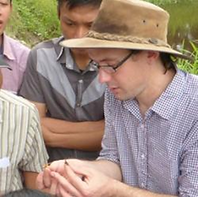
"If you bring agriculture and ecology together, it can be a of a mutual interest because we are trying things that are realistic from the start.”
Professor Ed Turner is the Curator of Insects at the Museum of Zoology in Cambridge, and a lecturer in Ecology at Cambridge University. I came across Ed Turners work whilst attending his Applied Ecology lectures in the subject of Agriculture and Ecosystem Services. During this lecture series, I found his work within the oil palm industry fascinating and could tell how passionately he spoke about his subject. As an ecologist, he had the ability to advise the oil palm industry on their practises whilst improving the ecology of the system and provides an interesting perspective as to why ecologists should be involved in sustainable agricultural development.
*All text in this interview is paraphrased and adapted from a conversation with Prof Turner.
Tell me about what motivated you to work in sustainable agriculture. Why do you think it’s important for ecologists to work in this field?
Mine’s not going to be an unsurprising answer really. I have always been interested in natural world and I grew up in rural Essex, most of rural Essex is farmland, that's mostly what you see. So I grew up around farmers and went to school with the farmers as well so it was something that was always kind of familiar to me. Then I started to do a bit of tropical research so did my PhD which was based in South East Asia and that was in rainforests. It ended up being all about the effects of Oil Palm expansion on rainforests because it is so obvious in the region and large parts of the tropics that cropland was expanding. So whether you're interested in core ecology or conservation science, agricultural landscapes are really important because they're just everywhere. Working on these areas just makes sense.
Maybe there is a bit more of an intelligent answer than that. I think that finding agricultural practises which don't reduce biodiversity, or compliment biodiversity whilst increasing yields is not a simple answer. With conservation I think, whilst incredibly important, most of the time it's about conserving pristine and as large and connected ecosystems as possible. I think probably most people agree with that now. However, what’s best in agricultural landscapes is really hard to tell. There are lots of different ways you can improve agricultural sustainability, and they come with costs and benefits, and that's the sort of place where I think a researcher can have real influence.
Throughout your career, you have worked alongside farmers in your research. Could you give an example of a time that working alongside stakeholders has taught you something new or changed the way that you’ve approached a research problem?
So I think probably that's the case for nearly every project we’ve done within oil palm really, as most of them have been about interventions on farms. Most of the ideas therefore did come from the oil palm industry. The project we have been running for the last few years has been a restoration project to restore river margins within established large scale industrial plantations in Indonesia. The reason we did that was basically because of questions from farmers at a Round Table on Sustainable Palm Oil (RSPO) conference. One of the main questions from the delegates attending the conferences was how best to restore river margins. When hearing this discussion, we realised that there was little evidence on how best to do that and so that basically started out the project. During discussion on river margin restoration, there were loads of questions from the audience, a mixture of small holder farms, industrial plantations. So it is very common to involve the stakeholders in discussions surrounding environmental action in oil palm.
It is the same with our industry practise as well. Our project before then was investigating the benefits of understory management in oil palm plantations and whether you gain a more diverse understory when not spraying herbicides and whether that comes, at a cost to yields. Furthermore, we investigated whether higher levels of understory management comes with benefits to biodiversity and associated ecosystem functions and services. The reason we did that was because one of the key oil palm managers in the area we worked in at the time had been reducing herbicide spray because he had thought that it was financially and environmentally costly.
How did you find that the farmers responded to the involvement in that research?
Farmer involvement (land managers and small scale farmers) are crucial for our project because they allow us to measure everything including yield. In addition, plantation managers will be thinking on wide scale, so within these businesses you get a research community who speak the same scientific language as ourselves but maybe have expertise in production or agronomy. Therefore the idea on how you set experiments up on farms and collect the data are already there. They are thinking about these things already. They give a different angle to our research through giving more consideration to the economics and land management than we do. If you bring those things together, it can be a of a mutual interest because we are trying things that are realistic from the start. So there are loads of ways that you can connect with people who are doing very different jobs. All those different components of the large industrial business can give insight.
In your opinion, what are the key difficulties for collaboration between ecologists and farmers? How do you think that this could be overcome?
We have to be honest, I’ve had lots of positive experiences and I’ve hardly had a negative one actually. I suppose you can be coming at questions from a very different direction where you might be focused on the environment or biodiversity. I think it's possible you come up with solutions that aren’t realistic or might be just very difficult to implement. Yes, it is a difficulty and farmers are very busy people. There is a lot of expectation on what they are meant to be doing; are they producing yield?; are they doing this sustainably?; or are they managing for ecosystem services now? It's not something you can just expect people to do.
With the oil palm industry, there are a lot of criticism because of the impacts on tropical deforestation. At the same time, with more sustainable practises and sustainability schemes such as the RSPO, there's been expectation that environmental assessments be carried out or for oil palm plantations monitor biodiversity on their estates. That’s quite a big ask. To make that happen, you have to have infrastructure in place and collaborations, maybe a bit like ours which can sometimes help with that. So going back to your question, I think things that can go wrong are that the disciplines might have very different expectations and also just another lack of awareness of where the different people coming from.
What can ecologists do to increase farmer participation in ecology and decision making?
An understanding of how ecosystems work is really useful and farmers do have that but they don't, necessarily approach environmental issues in the same way as an ecologist does. So I think there are core ideas from ecology (the relationship between biodiversity and ecosystem functioning and evolutionary principles) that ecologists can bring and you can apply to farming. I think that's done, but it's not really done enough. So I think that's where those sorts of insights can be really useful because often just not the way that an agronomist or farmer would think about things because they have different priorities and skill sets.
Is there anything else I’ve not asked you about which you think is relevant or interesting?
I think there’s an unexpected nature as well with working in this interdisciplinary area. If you do work in these kind of areas, you do get interesting insights which you wouldn't do otherwise, I think. I think it's healthy for people to work in more diverse groups of people because I think you kind of end up learning new things, which I think is really useful. So knowing more about how oil palm is grown has been really interesting, actually a little bit more about the social side of things as well. Working in this way has opened up other areas of research for us and other areas of interest.
Professor Ed Turner is the Curator of Insects at the Museum of Zoology in Cambridge, and a lecturer in Ecology at Cambridge University. I came across Ed Turner's work whilst attending his Applied Ecology lectures in the subject of Agriculture and Ecosystem Services. During this lecture series, I found his work within the oil palm industry fascinating and could tell how passionately he spoke about his subject. As an ecologist, he had the ability to advise the oil palm industry on their practises whilst improving the ecology of the system and provides an interesting perspective as to why ecologists should be involved in sustainable agricultural development.
Also the other thing is the speed in which farmers or maybe particularly the oil palm industry can work is extraordinary. It takes years to try and get a government change or anything like that. Policy changes don't seem to happen very fast, although I’m not involved in the area very much. However working with oil palm managers, we have made a recommendation and then will come back the next year to see whole estate changed. This shows how it can go really fast if you come up with something that is realistic.
Comments