

"Growing Together: Farmer-Academia Collaboration with Prof. Michael Lee"

"Farmers care about what they produce and how it's produced"
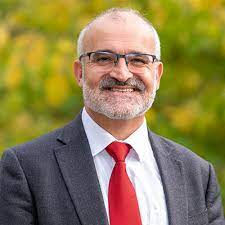
When thinking about starting this blog series, Michael Lee was one of the first people that I thought that I would want to interview. Not only is he the Deputy Vice Chancellor of Harper Adams University, a place where I spent a happy 5 years as an undergraduate, but he is also a previous president of the British Society of Animal Science and the President of the European Federation of Animal Science, Livestock Farming Commission. His wealth of experience, both working on farms and in academia makes him an expert in both livestock systems but also positive impacts that they can have on environmental and human health.
*All text in this interview is paraphrased and adapted from a conversation with Prof Lee.
Tell me about what motivated you to work in sustainable agriculture. Why do you think it’s important?
The motivation to work in sustainable agriculture started from a very young age. My maternal grandfather had a dairy farm in Ireland. Although my mother did not inherit the farm, I was always interested in how the farm could deliver not only a high quality, nutritious product at the same time as providing an amazing environment. This is something that really drove my career. I then did my undergraduate degree at Aberystwyth. During the degree I really enjoyed the animal nutrition elements so decided to do my PhD in ruminant nitrogen use efficiency. My first post-doctoral research post was in lipid metabolism. Since then, I have been a promoter in the value of animal products, particularly ruminant meat, for human and environmental health. It is clear from the work of myself and like-minded colleagues that livestock are part of a circular system. The reason why this system is broken is that we have over consumed those products. To solve this, we want to promote eating less but higher quality livestock products, such as those produced by UK farmers. This scientific reasoning has really marked the story of my career. Every bit of scientific research that I have done has clearly articulated that and I will keep banging that drum until someone provides me with evidence that I am wrong.
Throughout your career, you have worked alongside farmers in your research. Could you give an example of a time that working alongside stakeholders has taught you something new or changed the way that you’ve approached a research problem?
I have many examples of this. It often is the case that I will go to a farm and see that they have a wealth of environmental knowledge and it will normally come down to how we can support farmers in the best way that we can. I was lucky enough to work in India where we were trying to reduce the environmental footprint of livestock systems, particularly of goat husbandry. Firstly, we needed to understand why the animals were being kept in a certain way and being fed certain diet. On the surface, it actually seemed that the farmers would do a lot better cultivating crops on this land, which could result in a higher overall protein yield. However through visiting the farm it was clear that the farmers were using the goats as part of circular system. They were harvesting the manures to feed fish within a pond which were then delivering algae that was going back into the goats ration. Also they were using the fish as a valuable resource, as they were removing nitrogen from the stream, preventing eutrophication. There are also many examples in UK agriculture with systems integrating crop and livestock production on fields.
In your opinion, what are the key difficulties for collaboration between environmentalists and farmers? How do you think that this could be overcome?
The key difficulty with collaboration is trust. Its about working together to understand where both parties are coming from and at the moment there is a divide. Farmers are environmentalists as well as producing food. Some environmentalists would ideally only consider environmental services without considering food production. Therefore there needs to be a coming together of minds. There are going to be parts of the planet which of course we need to conserve for nature absolutely but the vast majority of the land mass is going to have to produce food for a growing population that is probably going to plateau at between 10-11 billion. To make this work, we need to consider biodiversity and environmental components, but the majority of that land will be producing food. Although most farmers and the environmentalists are doing or trying to do the right thing. For the small minority of them that aren’t, we need to point those people out and put them on the correct path.
Another challenge to collaboration is that farmers live pretty isolated lives and the age bracket of the majority of UK farmers is 50-60 years old. This means that when a farmer is being supported, it needs to be a friendship, a meeting around a table over a cup of tea. Conversations with the farmer should start with what is important to the farmer such as the great quality food they are producing. Never start the conversation with the changes you suggest to make on the farm or criticisms about their environmental impact.
What can environmental and agricultural researchers do to increase farmer participation in environmental research and decision-making?
A way to getting farmers into environmental meetings which are often extremely academic, is by making them less academic. This is something that we (Harper Adams University) are trying to achieve with our School of Sustainable Food and Farming. We are trying with this to act as a ‘translator’ between academia and farming. One of the key mechanisms to the success of the school is that we have the National Farmers Union embedded into it. If we want to interview or include farmers in environmental research, we need to use a body which is going to represent farmers. This body will call use out when we use the wrong language, tell us how to remove it. It is embedded into our program from day one.
Secondly you should think about the endpoint of the research should not just be a paper in nature or science, it should be a set of workshops and on farm events to show actually what we should start doing and how we can learn from farmers.
Is there anything else I’ve not asked you about which you think is relevant or interesting?
Let’s not forget that agriculture is there to feed the planet, and we are going to need it if we are going to have a population that want to live in cities and therefore there is going to have to be a rural community that are going to have to feed those people. To make improvements in this area, we need to stop making broad brush stroke statements about the environmental impact of agriculture and instead we need to consider why agriculture is in this position. We need to support our rural community and value our local production. If the UK can produce a food commodity which consumers want to purchase and can do it at a lower environmental cost then it is our environmental right to follow UN sustainable development goals to produce it here.
As much as I think I know about agriculture, my job is being an academic. The job that a farmer has is the day to day running of that business, dealing with the challenges and pressures. Farmers are not static. They are not waiting for the academic or government to tell them to do something to make their business better. They are doing it! Some of the best ideas are the ones that are happening on the ground within the farming community.
Comments