

Introducing the Teign Valley Facilitation Fund Farm Cluster Group
It was a pleasure to speak to Elliott Fairs, Facilitator for the Teign Valley Facilitation Fund Cluster Group in Devon. After being approached by a group of enthusiastic land managers in his area, he decided to take on the project and just after two years, the group have achieved a huge amount. Elliott has been very kind to share the group’s story, their successes, challenges and key tips for running a successful farm cluster group.
"The group was driven by the farmers"

About the Teign Valley
The Teign Valley is a steep wooded valley in Devon on the Eastern Boundary of the Dartmoor National Park.

In the beginning...
Elliott moved to Devon in 2017 and there was already a local farm cluster group, facilitated by the RSPB, and the group focussed on improving populations of the Cirl Bunting in the Teign and Exe Valley. Elliott joined the group as a member to meet like-minded land managers in the area, however after some time the group disbanded due to a lack of funding. Over the next few years, Elliott started to establish himself as an independent agricultural advisor and began to build up a range of clients who wanted to participate in the Environmental Land Management Schemes. As his business grew, a group of biodiversity focussed land managers asked Elliott if he would get the farm cluster group restarted using the Facilitation Fund. Initially, he thought that he couldn’t apply for the funding as an individual and contacted several organisations about whether they would be happy running the group. However, the land managers, determined to get a group running and have Elliott facilitating it, had found out that it was possible for Elliott to apply for the funding and act as the facilitator. After a conversation with the Rural Payments Agency (RPA), Elliott quickly became excited about running the group and improving biodiversity in the Teign Valley.
Officially starting the group...
Elliott and his group members were determined to focus on biodiversity. However, to ensure that they would be successful in securing the competitive Facilitation Fund, the group also applied to look at Natural Flood Management. After 3 months of putting together an application, setting up an official steering group and getting a group agreement together, they had begun! The cluster started with 24 members and just over 1000 hectares of land. At first, the biggest challenge for Elliott, was having to foot the group costs for the first three months, which is a particular challenge if you are self-employed!
Two years in, what have the group achieved?
“I mean, to me, it seems as though it's just progressing nicely, but a lot of people from outside are saying, how have you managed to achieve so much in such a short period of time?”
The first year was spent ensuring that everyone knew each other and figuring out the funding system and alongside monthly ecologically focused meetings, walks and talks. The second year was when it started to get exciting. For the Teign Valley group, their focus was to improve the prospects of key species within the valley. Elliott therefore made it his aim to raise awareness about how farming methods affect key species living in the valley and to conduct a survey about their occurrence. As a result, the group now have a much better idea of Greater Horseshoe Bats, Dormice and Brown Hairstreak Butterflies and hope by the end of the three-year funding window that they will have much better data for the distribution of species in their area to support Biodiversity Net Gain and responsible development.
The group host a variety of biodiversity knowledge exchange events
(Left: bat walk, Centre: hedge talk, Right: glow worm event)
Credit to the Teign Valley Facilitation Fund Group
Collaboration is at the heart of farm cluster groups, and the Teign Valley Facilitation Fund are taking this to the next level through collaborating with their local community. For instance, the group are working with a local Angling Society to look at electro fishing and also to improve their knowledge of where Salmon are found in the River Teign and its numerous tributaries. Another important collaboration is with the local church, where the cluster group have supported the installation of Swift boxes into the church towers, involving acoustic lures and regular surveys.
“They've never experienced anything that actually united every single landowner, be them arable, livestock, mixed farming, forestry, public or private, but every single landowner unites and gets behind a project that involves reducing deer numbers.”
Elliott described the biggest success as their deer management group which, although wasn’t an aim at the start, has recently become a national priority in agriculture due to ever escalating deer numbers (https://www.fwi.co.uk/news/environment/environmental-issues-wildlife/how-farmers-can-tackle-the-booming-deer-population). In fact, due to the importance of this issue within the agricultural sector, the deer management group has substantially increased the membership of the farm cluster. Within this part of the group, the members hope to raise awareness of eating and selling venison and have even participated in online events to encourage more organisations to get involved.
The increase in group coverage will increase the scale of the group's impact.
(Left: historic coverage Right: current coverage)
Credit to the Teign Valley Facilitation Fund Group
Every successful group has challenges...
The successes of the cluster are not without their challenges. In particular, the uncertain funding landscape for environmental land management in England makes them concerned about their longevity. Elliott is hoping that the new Farmer Collaboration Fund (https://www.gov.uk/government/news/reynolds-backing-farmers-with-a-new-era-of-partnership-to-boost-farm-profitability) will be available to the group in the future to allow them to continue their fantastic work!
Another key challenge is growing the group whilst ensuring that all members are aligned with the aims of the cluster. To this end, Elliott lets his group grow organically rather than actively recruiting new members. Although this leads to having a very engaged and proactive group, it can sometimes feel like an echo chamber as everyone in the group have similar perspectives on how their land should be managed. Furthermore, as there aren’t many large and commercial farms in the Teign Valley, and many of the land managers want to manage for biodiversity, the concept of food security or agricultural business profits aren’t as high up the agenda of this group as much as it does for others in England.
Elliott's top tips for running a successful farm cluster...
Have a good, clear aim about what you want to achieve.
Don’t just aim for more members or acres, it is better to deliver less and do it well than to over-reach and not deliver.
Get yourself an identity so that the group have a good idea of who they are and what they are trying to do. This even comes down to the way you market yourself and logo.
Ensure every event has built in time for networking, and general chit chat at the start, middle and end of every event – this is where the real magic happens!
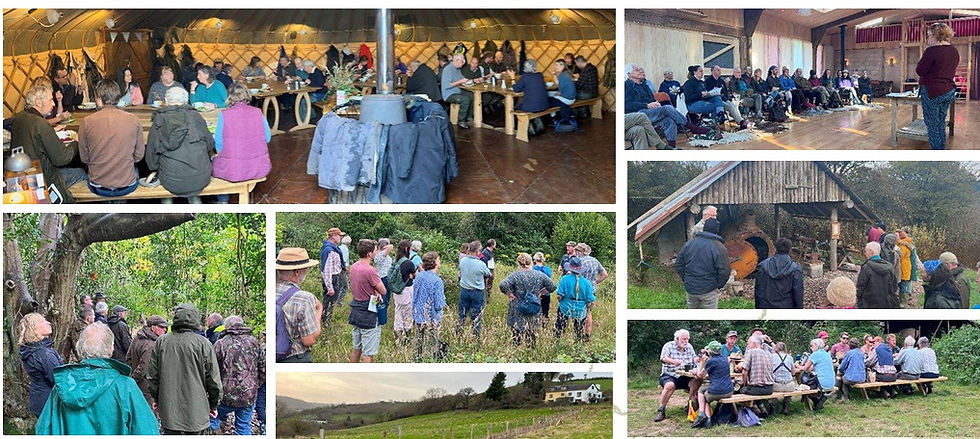
Getting people together is at the heart of the Teign Valley Facilitation Fund group.
Credit: Teign Valley Farm Cluster
To find out more...
Please visit the Cluster Group's website: https://www.tvff.co.uk/ or contact Elliott (contact details below).
What is a farm cluster?
Started by the Game and Wildlife Conservation Trust in the early 2010's, farm cluster groups are collaborative groups of farmers and land managers working towards environmental objectives. Many groups do this through providing knowledge exchange opportunities and connecting farmers with funding opportunities for environmental land management. Farmer Clusters - For farmers, facilitators and advisors

Until next time...
The next blog post will look at the fantastic rewilding project on the Sharpham Estate (https://www.ambios.net/rewilding-at-sharpham/).


Comments